Dronalize
An open-source toolbox for unifying trajectory prediction research across bird's-eye-view and motion-forecasting datasets.

Dronalize is an open-source toolbox that aims to consolidate the research and development of trajectory prediction models. It started as a smaller project focused on drone-captured, bird’s-eye-view datasets, and it has since grown to support a wide range of popular motion forecasting benchmarks. The toolbox provides utilities for data preprocessing, visualization, and evaluation, together with a model-development pipeline tailored to machine-learning-based trajectory prediction.
It is built on PyTorch, PyTorch Geometric, and PyTorch Lightning, and it is released under the Apache 2.0 license.
Motivation
Trajectory prediction research is spread across many datasets, each with its own formats, coordinate conventions, map representations, and evaluation scripts. That fragmentation makes it hard to compare methods fairly or to reuse code across benchmarks. The accompanying paper, Toward Unified Practices in Trajectory Prediction Research on Bird’s-Eye-View Datasets, argues for a common set of practices, and Dronalize is the practical tooling that puts them into effect. The goal is a single, consistent pipeline from raw dataset to trained model to evaluation, so that researchers can spend their time on modeling rather than on plumbing.
Supported datasets
Dronalize began with drone-captured datasets and now covers more than twenty benchmarks that span highways, intersections, roundabouts, pedestrian scenes, and dense urban traffic. Most are freely available for non-commercial use, though some require registration.
- Drone-captured: highD, inD, rounD, exiD, uniD, openDD, AD4CHE, SIND, A43, INTERACTION
- Instrumented-vehicle and other: Argoverse 1 and 2, Waymo Open Motion Dataset, nuScenes, Lyft Level 5, View-of-Delft, ApolloScape, NGSIM (I-80 and US-101), ETH, UCY
Each dataset is handled through a dedicated preprocessing pipeline and configuration, which converts its native format into a common representation (agent trajectories plus a lane graph) that the rest of the toolbox consumes. The full list, with download links and per-dataset instructions, lives on the datasets page of the repository.
A unified pipeline
The toolbox is organized as a sequence of interchangeable stages, so that a model written against one dataset runs against any other with only a change of configuration:
- Preprocessing converts each dataset into the common trajectory-plus-lane-graph format.
- Data loading serves the processed scenes as batched graphs through PyTorch Geometric.
- Modeling provides a base interface and reference models to build on.
- Training is driven by PyTorch Lightning, with reproducible configs and containers.
- Metrics implements the standard prediction measures (such as ADE, FDE, and miss rate) consistently across datasets.
Because preprocessing, data loading, training, and evaluation share one representation, a result obtained on one benchmark is directly comparable to a result on another.
Visualization
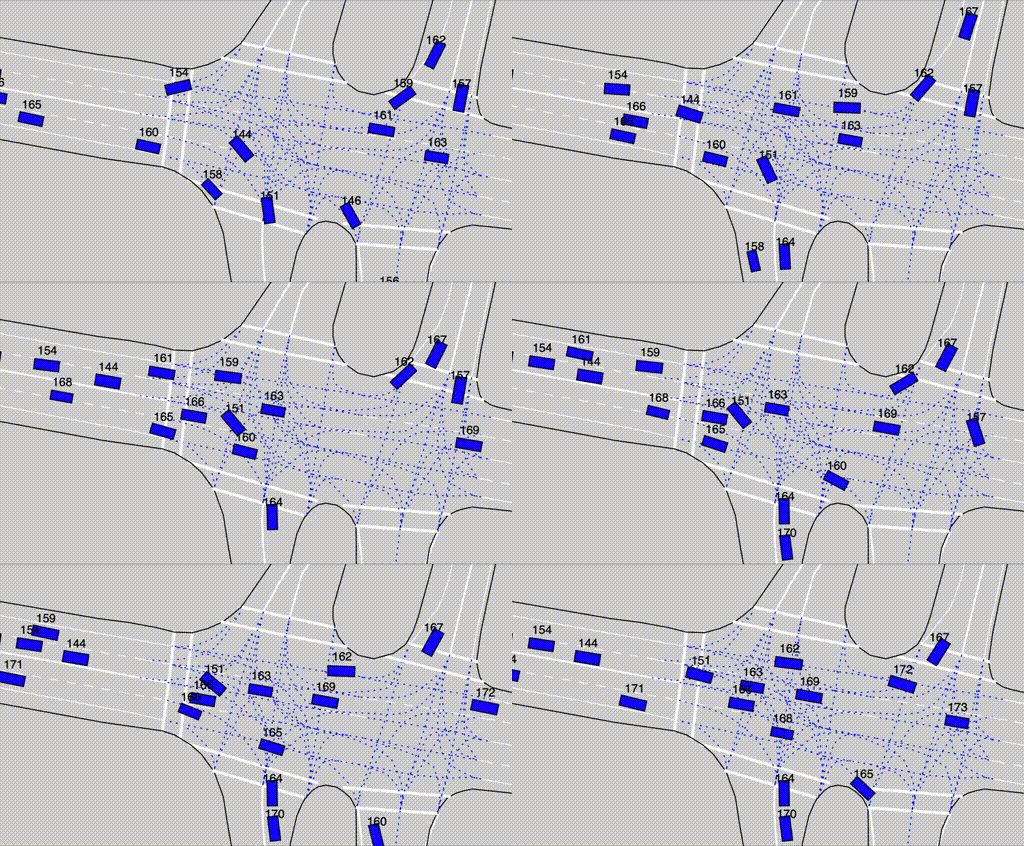
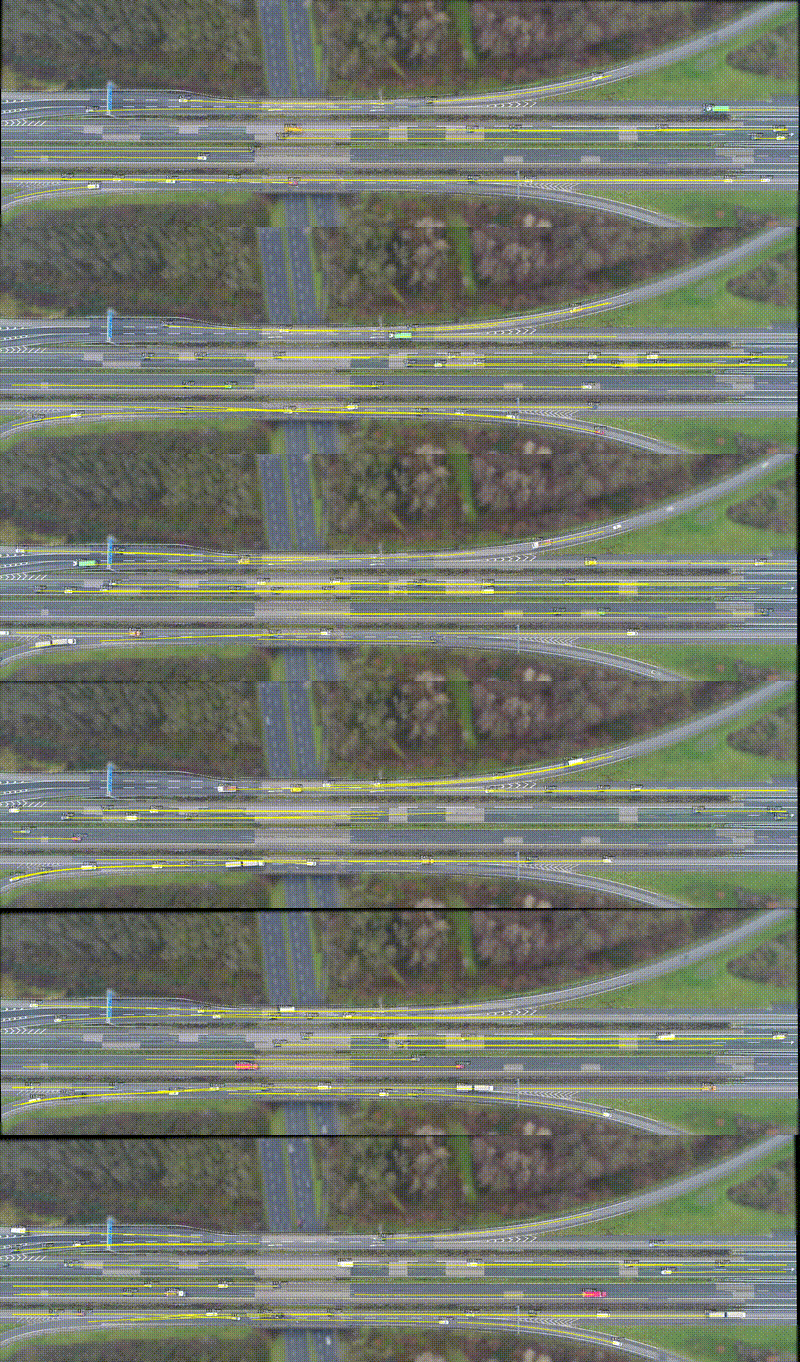
A core feature of the toolbox is its visualization utilities, which render scenes, lane graphs, and predicted trajectories directly from the processed data. These make it easy to inspect a dataset, debug a preprocessing step, or present qualitative results.
Baseline models
Two reference models ship with the toolbox so that new methods have a point of comparison:
- A lightweight prototype model that serves as a simple, readable baseline.
- MTP-GO, a graph-based probabilistic predictor built on neural ordinary differential equations, which provides a stronger reference point.
Example use case: transfer across datasets
One motivation for a unified pipeline is that it makes cross-dataset experiments straightforward. In the accompanying paper, the toolbox is used to study domain adaptation and generalization: the prototype model is pre-trained on one dataset and fine-tuned on another, and vice versa. Even with a very simple architecture, transfer learning yields clear improvements, which is only practical to measure because the datasets share one representation and one evaluation path.

The toolbox also underpins our follow-up work on transferability, Unveiling Transferability in Trajectory Prediction via Latent Scene Embeddings, which was presented at ECCV 2026. That study uses Dronalize’s unified multi-dataset pipeline to analyze how learned scene representations transfer across benchmarks. Code and a project page are available at westny.github.io/transferatlas.
Related work
The toolbox grew out of, and continues to support, several research projects on behavior prediction:
- Unveiling Transferability in Trajectory Prediction via Latent Scene Embeddings, ECCV, 2026.
- Diffusion-Based Environment-Aware Trajectory Prediction, arXiv preprint, 2024.
- MTP-GO: Graph-Based Probabilistic Multi-Agent Trajectory Prediction with Neural ODEs, IEEE Transactions on Intelligent Vehicles, 2023.
- Evaluation of Differentially Constrained Motion Models for Graph-Based Trajectory Prediction, IEEE Intelligent Vehicles Symposium (IV), 2023.
Cite
If you use the toolbox in your research, please consider citing the paper:
@inproceedings{westny2025dronalize,
  title={Toward Unified Practices in Trajectory Prediction Research on Bird's-Eye-View Datasets},
  author={Westny, Theodor and Olofsson, Bj{\"o}rn and Frisk, Erik},
  booktitle={IEEE Intelligent Vehicles Symposium (IV)},
  year={2025}
}